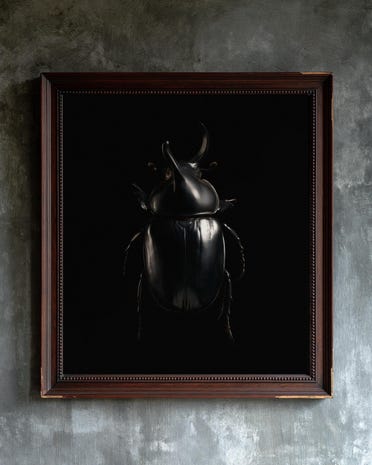
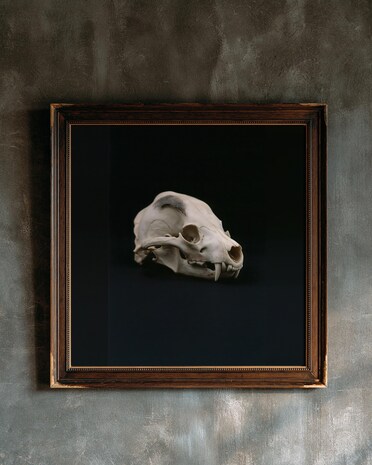
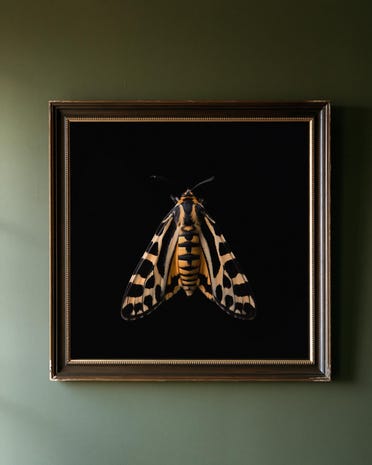
Introducing the new Duskwood Fell collection — insects, bones, feathers, and dark botanicals, photographed against true black.
There is a particular kind of museum room that most visitors walk past. It sits off the main hall, past the dinosaurs and the dioramas, and it is usually lit low — a room of shallow drawers and glass-topped cases, each one holding something small and labelled and utterly still. A beetle. A feather. A skull the size of a plum. Nobody performs in that room. People lower their voices without being asked.
That room is what this collection is about.
The new set is fifty-five photography prints, and every one of them works the same way: a single specimen, photographed against true black, lit so that the dark swallows everything except the subject. A death’s-head hawkmoth with its wings open, the pale skull marking clear on its thorax and one forewing worn thin with age. A fox skull facing forward, canines intact, the muzzle smoothed by years. An ammonite broken open at one edge so the chambered spiral shows. The black is not a backdrop so much as a depth — the subject seems to float in it, the way things float in memory.
Why true black, and why now
October is the month the culture gives us permission to decorate with the strange, and most of what gets sold under that permission is loud. Plastic, orange, grinning. But there has always been another register of Halloween — older, quieter, closer to the natural history cabinet than the costume shop. The collector’s register. The drawer of things found on walks and kept because they meant something: a raven feather that nearly disappears into the dark behind it, a hag stone with a single hole worn through its center by a century of tides.
Prints in this register do not read as seasonal decoration. They read as belongings. Which is why they survive the season — a bat folded inverted, wings wrapped around itself like a cloak, is a Halloween image in October and simply a beautiful, restrained gothic portrait in January. The blackthorn branch with its dusty blue sloes is autumn now and still right when the frost comes. True black keeps everything in the same low light, so the wall never changes temperature when the calendar does.
What lives in the drawer
The collection divides roughly the way a real cabinet would.
The insects are the largest wing of it — moths above all, from the death’s-head hawkmoth to an emperor moth staring outward through four owl-eye spots, along with beetles, a rim-lit praying mantis holding its forelegs in something close to prayer, and an amber cicada shell still gripping the branch it left behind. Some are jewel-like; some, like the wolf spider and the centipede, are frankly unsettling. Both belong. A cabinet with only pretty things in it is not a cabinet, it is a display.
The bones are fewer and heavier: the fox skull, a rabbit skull with its long curved incisors, a ram skull whose horns alone give it presence across a room, a cluster of vertebrae arcing like beads on an invisible thread.
The feathers are the soft tissue of the collection — raven, magpie, barred owl, heron — and the botanicals are its wild edge: witch hazel with its spidery yellow petals on gnarled bark, a dried rose crisped to dark parchment, a physalis lantern skeletonised to a lace cage around the orange berry inside. And then the sea things and curios: a whelk shell, a worn sea urchin, the ammonite, the hag stone, a shed snake skin torn open at the head.
Where they go
These prints are built for grouping, though any one of them can hold a wall alone.
The natural home is a study wall — six or nine frames in a loose grid, moths and bones and feathers mixed, the way a real cabinet mixes them. Matched thin black frames and generous white mats do most of the work; the true black grounds unify everything else.
A single dramatic piece — the ram skull, the backlit bat with its wings spread and glowing faintly at the edges — earns the space above a reading chair, where it can be looked at slowly, in lamplight, which is the light these photographs were made for.
And a hallway takes the long view: a gallery run of small frames down its length, one specimen after another, so that walking to the kitchen becomes a short tour through the drawer. The stick insect and the heron feather, both long and narrow, were nearly designed for this.
Because everything shares the same black ground, you can start with three prints and add a fourth in November and a fifth after the new year, and the wall will absorb them as if they were always there. Collections are supposed to grow. That is the pleasure of them.
The practical part, briefly
Each print is a high-resolution digital download — five files covering every common frame size from 4x6 to 20x30, plus the ISO A-series — so you can print at home this afternoon or send files to a print shop for something larger. No shipping, no waiting, no crushed corners.
The full drawer is open now at the Duskwood Fell Etsy shop, where all fifty-five specimens are listed individually. Take your time. The room is lit low on purpose.
From the shop
Prints from our own Duskwood Fell shop that suit this room. Instant digital downloads, printed at home or at any print shop.